
Inward Spiral Matrix Program in Java and Python
Inward spiral matrix variation with boundary-update algorithm, explanation, Java solution and simple Python solution for ICSE and ISC students.
Question:
Write a program to fill a square matrix of size n × n in spiral fashion with natural numbers, but fill the values from n × n down to 1 so that the final arrangement appears as the inward variation of the circular spiral matrix.
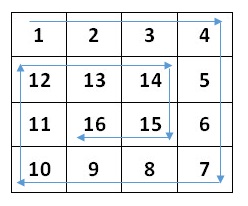
Algorithm:
Step 1: Start.
Step 2: Accept the matrix size n.
Step 3: Declare square matrix A[n][n].
Step 4: Initialize k to n × n so filling starts from the largest value.
Step 5: Initialize row boundaries r1 = 0 and r2 = n - 1, and column boundaries c1 = 0 and c2 = n - 1.
Step 6: Repeat while k is greater than or equal to 1.
Step 7: Fill the top row from c1 to c2, store k and decrement k after every cell.
Step 8: Fill the right column from r1 + 1 to r2, store k and decrement k after every cell.
Step 9: Fill the bottom row from c2 - 1 down to c1, store k and decrement k after every cell.
Step 10: Fill the left column from r2 - 1 down to r1 + 1, store k and decrement k after every cell.
Step 11: Move r1 and c1 inward by increasing them, and move r2 and c2 inward by decreasing them.
Step 12: Continue the loop with the updated boundaries so the next cycle fills only the inner unfilled layer.
Step 13: Display the matrix after all values from n × n down to 1 have been placed.
Step 14: Stop.
Explanation:
The spiral matrix is filled layer by layer. Four boundary variables are used: r1 and r2 for the top and bottom rows, and c1 and c2 for the left and right columns.
Each loop fills one side of the current layer. The first loop fills the top row, the second fills the right column, the third fills the bottom row, and the fourth fills the left column.
The variable k stores the next decreasing number to be placed in the matrix. It is decreased after every assignment so every cell gets a different value.
After one full boundary is filled, the row and column limits are moved inward. This boundary update prevents the next cycle from overwriting the layer that has already been filled.
The process stops when k becomes less than 1, which means all numbers from n × n down to 1 have been assigned to the matrix.
This spiral variation still depends on controlled movement through matrix boundaries, but the direction or starting point may differ from the standard spiral. The program must keep track of the current row, current column, direction and active limits. After completing one side of the spiral, it changes direction and tightens the boundary. The value counter is increased after every cell is filled. The method works because every movement is limited by boundaries that shrink toward the centre.
Java Program:
/**
* The class Circular_Matrix2 creates a Square Matrix of size n*n and fills it in a circular fashion
* @author : www.guideforschool.com
* @Program Type : BlueJ Program - Java
*/

import java.util.Scanner;
class Circular_Matrix2
{
    public static void main(String args[])
    {
        Scanner sc = new Scanner(System.in);
        System.out.print("Enter the number of elements : ");
        int n=sc.nextInt();

        int A[][]=new int[n][n];
        int k=n*n, c1=0, c2=n-1, r1=0, r2=n-1;

        while(k>=1)
        {
            for(int i=c1;i<=c2;i++)
            {
                A[r1][i]=k--;
            }

            for(int j=r1+1;j<=r2;j++)
            {
                A[j][c2]=k--;
            }

            for(int i=c2-1;i>=c1;i--)
            {
                A[r2][i]=k--;
            }

            for(int j=r2-1;j>=r1+1;j--)
            {
                A[j][c1]=k--;
            }

            c1++;
            c2--;
            r1++;
            r2--;
        }

        /* Printing the Circular matrix */
        System.out.println("The Circular Matrix is:");
        for(int i=0;i<n;i++)
        {
            for(int j=0;j<n;j++)
            {
                System.out.print(A[i][j]+ "\t");
            }
            System.out.println();
        }
    }
}
Equivalent Python Program:
# Read the matrix size and set the first value to be filled.
    n = int(input("Enter size of the matrix: "))
    A = []
    for i in range(n):
        A.append([0] * n)

    k = n * n
    r1 = 0
    r2 = n - 1
    c1 = 0
    c2 = n - 1

    # Fill one outer boundary at a time, then move the boundaries inward.
    while k >= 1:
        for i in range(c1, c2 + 1):
            if k >= 1:
                A[r1][i] = k
                k = k - 1
        for i in range(r1 + 1, r2 + 1):
            if k >= 1:
                A[i][c2] = k
                k = k - 1
        for i in range(c2 - 1, c1 - 1, -1):
            if k >= 1:
                A[r2][i] = k
                k = k - 1
        for i in range(r2 - 1, r1, -1):
            if k >= 1:
                A[i][c1] = k
                k = k - 1

        # Shrink the active row and column limits for the next inner layer.
        r1 = r1 + 1
        r2 = r2 - 1
        c1 = c1 + 1
        c2 = c2 - 1

    for i in range(n):
        for j in range(n):
            print(A[i][j], end="	")
        print()
Output:
Leave a Reply
Your email address will not be published. Comments are reviewed before appearing publicly.